
Visual ontology design
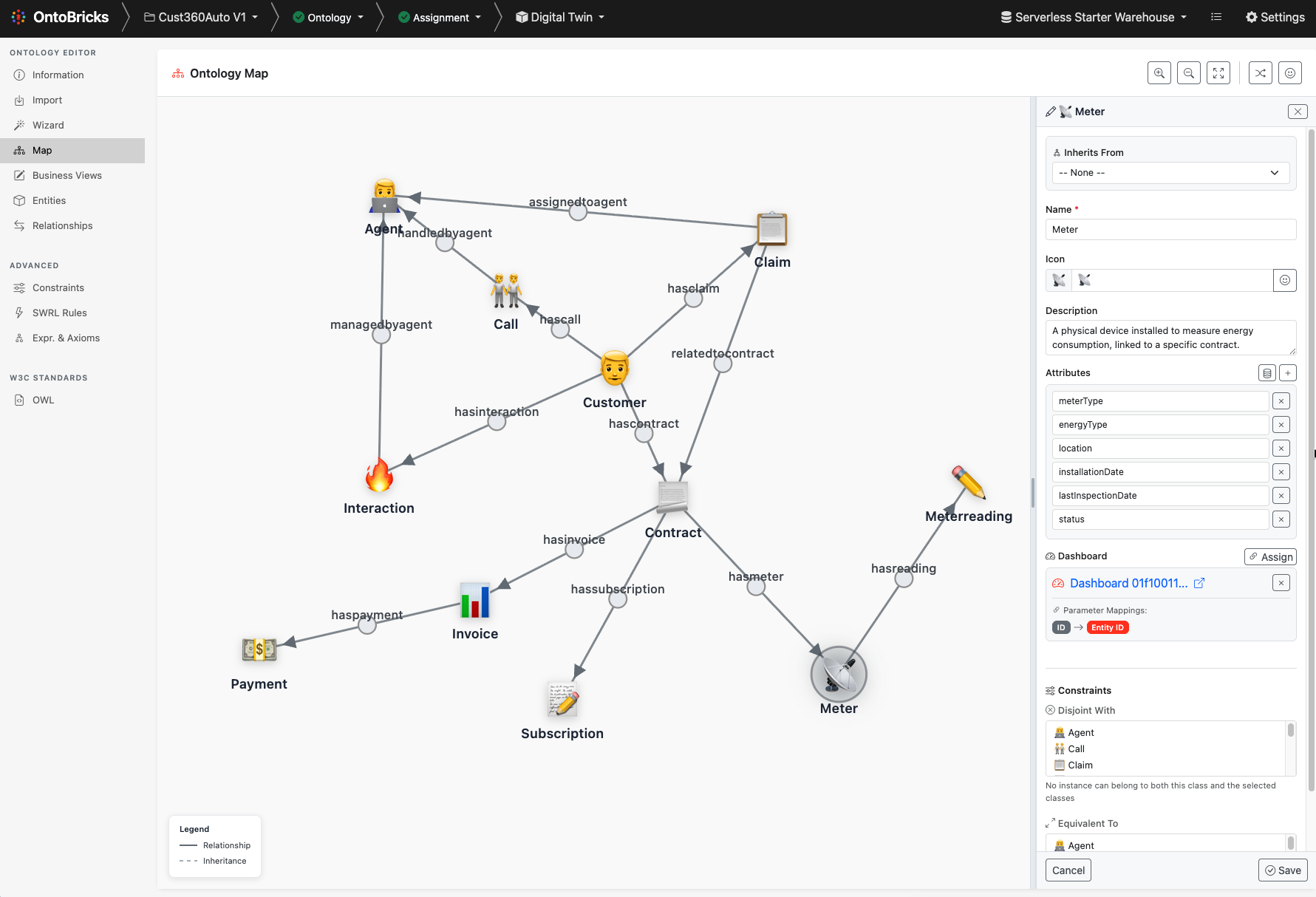
Drag-and-drop entities, relationships, and class hierarchies on the OntoViz canvas. Or import FIBO, CDISC, IOF and other OWL/RDFS standards.
OntoBricks designs ontologies, maps them to Unity Catalog tables, materializes or virtualizes triples into a triple store, reasons over the graph, and serves it to your apps and AI agents — the full pipeline in four clicks.
Ontologies in OWL — visually or LLM-generated
Entities to Unity Catalog tables via R2RML
OWL 2 RL, SWRL rules & SHACL checks
GraphQL API & MCP for AI agents
OntoBricks brings ontologies, reasoning, and graph exploration to the Lakehouse — without leaving Unity Catalog or writing a single triple by hand.
Drag-and-drop entities, relationships, and class hierarchies on the OntoViz canvas. Or import FIBO, CDISC, IOF and other OWL/RDFS standards.
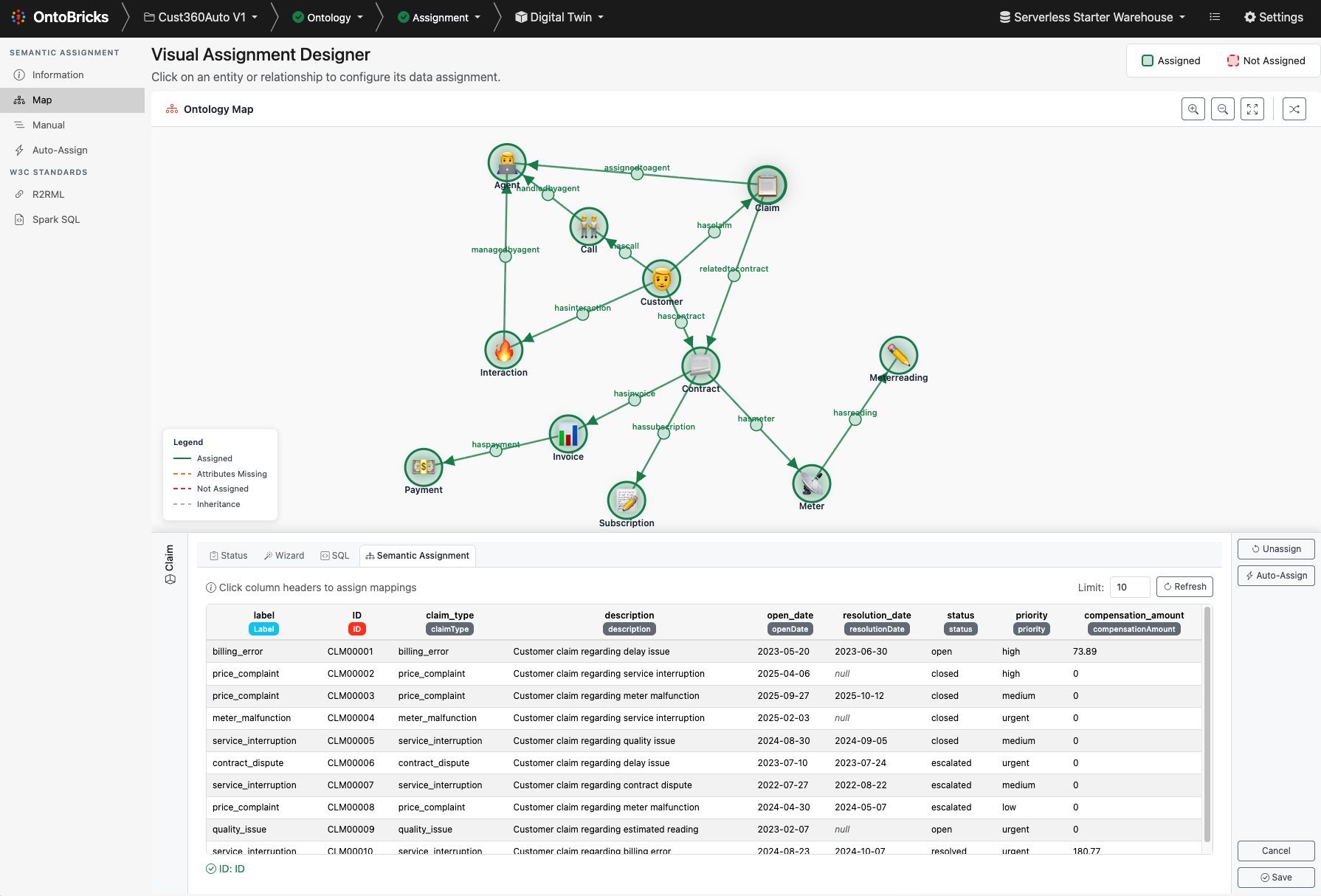
An LLM wizard writes the SQL that binds ontology entities to your tables, column by column — then auto-maps everything else in a single batch.
Materialize triples into the backend you choose — Lakebase (Postgres), Lakehouse (Delta) or Neo4j — incremental by default and no manual SQL, or keep them virtual with a live pass-through view over the Lakehouse.
Run OWL 2 RL deductive closure, SWRL business rules, transitive/symmetric expansion, and W3C SHACL data-quality validation over the graph.
A GraphQL schema is generated from your ontology at runtime — traverse nested relationships in a GraphiQL playground, per project.
Expose the knowledge graph to LLM agents through the Model Context Protocol — connect from Cursor, Claude Desktop, or the Databricks Playground.
LLM-powered automation handles the heavy lifting — you stay in control at every step.
Fetch table and column metadata straight from Unity Catalog. OntoBricks reads your schema so it understands what it's modeling.
An LLM designs entities, relationships, and attributes from your metadata — a fully editable starting point on the visual canvas.
Generate R2RML mappings for every entity and relationship, with multi-pass column matching and partial-mapping detection.
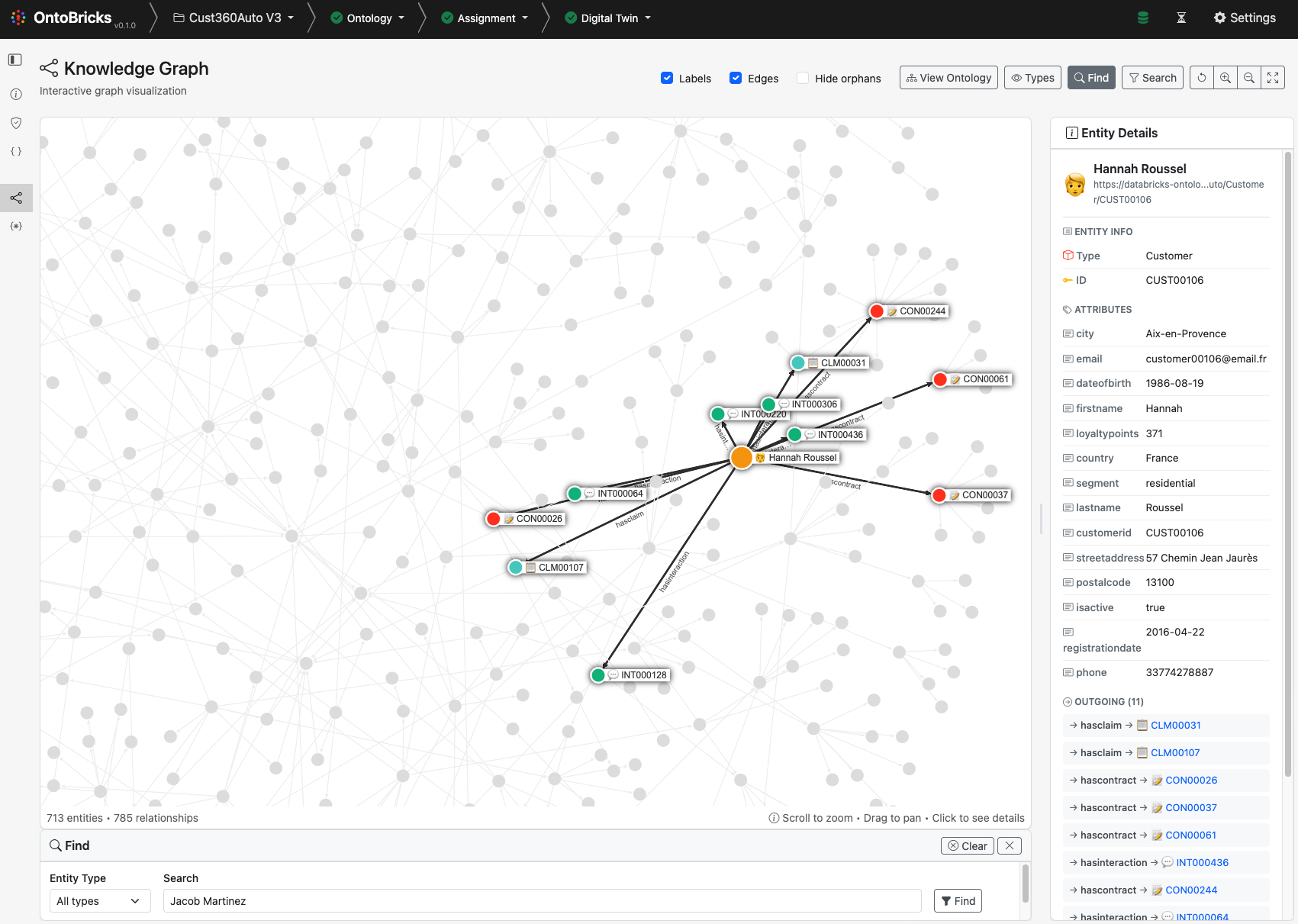
Materialize triples into the store, then query with GraphQL or explore the interactive, WebGL-powered knowledge graph.
Walkthroughs, release highlights, and deep dives. View the full playlist ↗
# Clone the repository
git clone https://github.com/databrickslabs/ontobricks
cd ontobricks

# Install dependencies with uv
uv sync

# Configure your Databricks credentials
cp .env.example .env
# edit .env → host, token, SQL warehouse ID

# Start the app → http://localhost:8000
./start.sh# Authenticate against your workspace
databricks auth login --host https://<workspace>
# Deploy as a native Databricks App
make deploy
# Then bind the sql-warehouse & volume resources
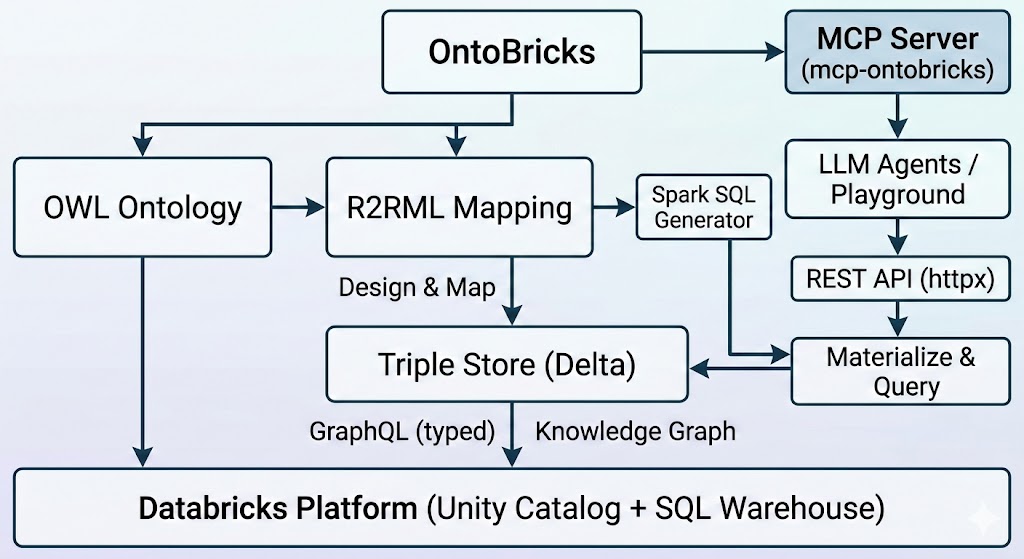
# in Compute → Apps → ontobricks → ResourcesOntoBricks stitches together semantic-web standards, graph databases, and formal reasoning on top of the Databricks Platform. Ontologies compile to R2RML, mappings become Spark SQL, and triples land in Lakebase, Delta or Neo4j — all governed by Unity Catalog.
OntoBricks is source-available under the Databricks License and welcomes contributions. See everyone on GitHub ↗
Released August 2026 — more flexible domains, more precise MCP publication, and a unified UI. Read the full release notes ↗
A new No Backend domain type lets you review and publish an ontology with no materialized graph — and still expose describe_ontology over MCP.
Each domain controls which graph tools it publishes, and whether datasets, bridges, actions and virtual attributes are preferred, normal, or disabled context.
Entities can declare values computed on demand by Unity Catalog functions — surfaced in Graph Explorer, REST and MCP without touching mappings, R2RML or materialization.
Lakehouse domains can expose a live pass-through VIEW over the mapping gateway instead of copying triples into a Delta table.
Refresh frozen IN-REVIEW and PUBLISHED graphs, and purge generated reasoning & cohort triples without touching your mapped source triples.
Configure the app title, primary color, logo and default entity icon — on top of a unified Clarity design system across every screen.
Source-available, Databricks-native, and yours to explore.